
The best poker players all, consciously or subconsciously, understand the math behind the game. Learn about the math behind Texas Hold’em poker here.
Home »
The Math Behind Texas Hold’em Poker
Poker is an intriguing game that is part luck and part skill. While chance means sometimes things don’t go your way, knowing how to play and narrowing down the possibilities can help you get an edge over your opponents. And the driving force behind this all? Poker math.
Whether you’re playing online poker cash games or online poker tournaments, there is essential poker math that separates average players from the best. Keep on reading to learn more about the math behind Texas Hold’em poker hands, as well as other elements of the game.
The Basic Rules of Texas Hold’em
Before you dive into the math behind this popular variant of poker, here’s a short summary of how Texas Hold’em works for anyone who is new to the game.
Texas Hold’em is a community poker game in which players must attempt to make the strongest hand possible using two cards that they are dealt, as well as five community cards.
Winning Poker Hands
The hands that players can make, from strongest to weakest, are:
- Royal flush: An ace, jack, queen, king, and ace of the same suit.
- Straight flush: Five consecutive cards of the same suit.
- Four of a kind: Four of the same card from the different suits.
- Full house: Three of a kind and a pair.
- Flush: Five non-consecutive cards of the same suit.
- Straight: Five consecutive cards from the different suits.
- Three of a kind: Three of the same value cards from the different suits.
- Two pair: Two pairs.
- Pair: Two of the same value cards from different suits.
- High card: The strongest single card in your hand.
Now that you know the win conditions for a game of Texas Hold’em, it’s time to look at how a game will generally unfold.
How a Game of Texas Hold’em Plays Out
The game begins with one player putting in a small blind while the player to their left has to put in a big blind. This is to ensure there is money in the pot before a hand starts.
After the blinds are paid, each player receives two cards. Players then decide whether they are going to fold, check, or raise. This is known as the pre-flop round.
Once the action in the pre-flop round has played out, the first three community cards are dealt. Again, players decide whether to fold, check, or raise. This is known as the flop round.
This is followed by the turn, which introduces a fourth community card. Again, players decide on their actions. This round is called the turn.
The final round introduces the fifth and last community card. Players decide on their final actions. This round is called the river.
If any players are left, every player must reveal their hand. This is known as the showdown.
Once all the hands are revealed, the player with the strongest hand wins the game.
How Mathematics Affects a Game of Texas Hold’em

The game that was described previously may sound purely like a game of chance. After all, the game begins with each player hoping to get good cards in their starting hand, while players also keep their fingers crossed that the community cards that appear in later rounds will also help them secure a win. However, to say poker is a pure game of chance is incorrect.
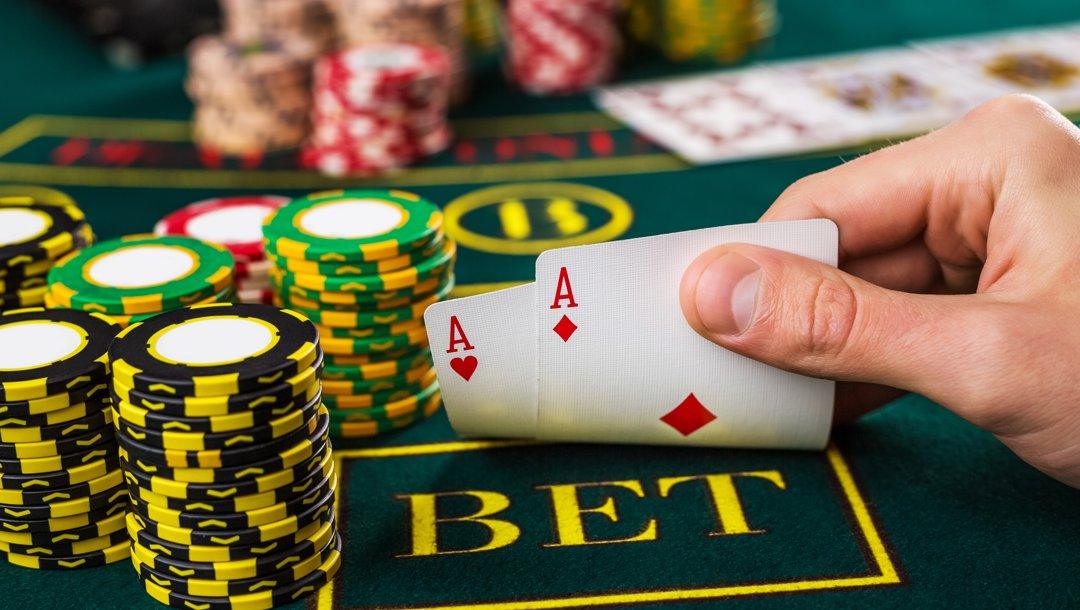
Good poker players know poker is about probability. More specifically, they understand how to process the information that they have available to them to narrow down their choices. This can range from knowing that, if they have a pair of aces pre-flop, they have the strongest hand in the game and can afford to play very aggressively to understanding poker ranges and the likelihood of an opponent holding a certain hand and whether they should fold, check, or raise.
At higher levels of play, this ultimately means the best poker players understand the mathematics behind every decision they make and how this allows them to optimize their decision-making. This may not guarantee them a win in every game, but it is one of the elements that will help them increase their poker wins in the long run.
While it would be great to cover all the areas of Texas Hold’em that are affected by math, this would end up being a course that would take you months to get through. Instead, here are a few different parts of the game where math plays an important role so that you know what to study as you deepen your knowledge of the game.
1. Your Starting Hand
Knowing how likely your starting hand is to win is one of the most basic but important parts of modern poker, but how do you know how strong your hand actually is?
The good news is that you don’t have to pull out a calculator and try to figure it out yourself. There are plenty of poker tools and resources that you can use to help you learn the strength of a particular starting hand without needing to do a single calculation.
If you’d like to memorize which cards are the best to start with, there are numerous charts that describe a hand’s strength relative to your position on the board and whether they are suited or off-suited. You can also use one of the many training tools available to commit a starting hand’s strength to memory.
2. Outs

An out is a community card that will improve the strength of your hand and, therefore, your odds of winning, but that is not yet in play. For example, if you have a pair of jacks, you know this is a good, but not a great, starting hand. An out would be a third jack, as this would give you three of a kind. You can calculate the chances of an out appearing using the following formula:
- Calculate the remaining number of cards in the deck: Total number of cards in the deck — the number of cards in your hand — the number of cards on the table.
- Count your outs: These are the number of cards that you need to reach your target hand.
- Convert this to odds: You can do this using the number of remaining cards in the deck vs. your number of outs.
- Convert this to a percentage: To make this even easier to understand, you can convert this to a percentage using this formula: denominator/(denominator + numerator) x 100.
3. Pot Odds
Pot odds refers to the total value of the pot compared to what you have to wager to stay in the game. For example, if there is a total of $200 in the pot, and you need to pay $50 to call, then the pot odds are +400. This information can help you decide whether to make a play or not by letting you know the risk involved. For example, if the pot odds are +2000, that means you could win 20x your wager.
However, pot odds also need to be combined with your chances of winning (for example, by calculating your number of outs) to be a useful mathematical tool for most players. Otherwise, you could be just trying your luck to win big on a hand that has a very low chance of winning.
4. Expected Value
Expected value (EV) is a shorthand method of identifying the value of a particular play if it was played out numerous times. The EV of a particular hand will differ depending on the context of a game, but it can help guide you toward the right decision in the long term.
Here is a formula that you can use to calculate EV:
EV = (probability of winning x what you win) ‒ (probability of losing x what you lose)
If you get a positive EV, you should call or raise. If you get a negative EV, you should fold.
Poker: It’s a Numbers Game
This article has only touched on a few of the important mathematical concepts behind poker, and there are many more to get to grips with. For example, there are many subtle changes to the game depending on whether it’s the pre-flop, flop, turn, or river that can dramatically affect the mathematical outcomes in a game. So, if you had any doubts before you read this piece, by now, it should be clear that poker is a numbers game, and you’re going to have to get good at math if you want to win.
Play Exciting Online Poker at BetMGM
If you’re interested in taking advantage of this newfound knowledge, want to have a good time playing poker, or both, BetMGM is the place to play. BetMGM’s online poker site has a range of exhilarating cash games as well as online poker tournaments for you to enjoy. There are also popular variants for you to choose from, including Texas Hold’em, Seven-Card Stud, and Omaha.
And if you like more than just online poker, you can also try your luck playing online casino games. From online slots to table games to live dealer casino games, there’s so much on offer at BetMGM.
Register at BetMGM to play poker online and enjoy all the other gambling thrills available.